Basement Waterproofing in Ramapo, NY: Interior Drain, Exterior Drain, or Both?
Basement Waterproofing in Ramapo, NY: Interior Drain, Exterior Drain, or Both?
If you've got a damp or actively wet basement in Ramapo, you've probably already found a dozen contractors ready to sell you a system — but the right system depends entirely on where your water is actually coming from, not on which package a salesperson happens to be pushing that week. In Ramapo specifically, where clay-rich soil along the Ramapo River corridor and in lower-lying areas like Spring Valley expands and holds moisture, and where roughly 95-100 freeze-thaw cycles a year keep that soil saturated for long stretches, understanding the real difference between interior and exterior waterproofing is worth ten minutes before you sign anything.
What's Actually Causing Your Basement Water Problem?
This is the question that determines everything else, and it's worth answering honestly before looking at any system. Water gets into a basement three fundamentally different ways: surface water and poor grading directing rain toward your foundation, groundwater and hydrostatic pressure pushing against or up through the foundation from a high water table, and wall seepage from sustained soil saturation against the exterior with no active flooding. Each of these calls for a different fix, and a contractor who proposes the same system regardless of which one you actually have isn't diagnosing your problem — they're selling a product.
Interior Waterproofing: What It Actually Solves
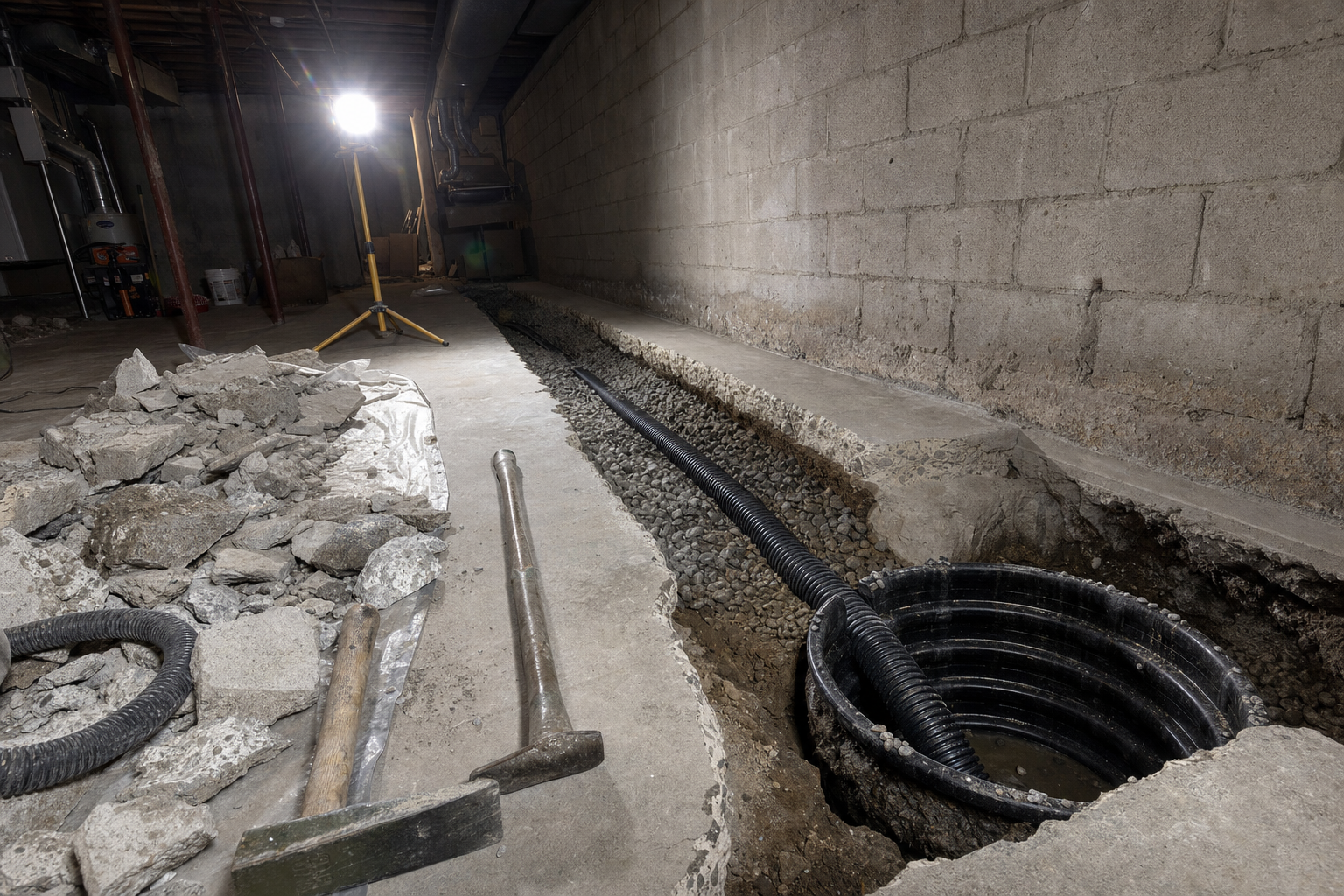
An interior perimeter French drain — a perforated pipe installed along the inside edge of your basement floor, feeding into a sump pump and basin — is the standard, most common solution, and it's the right call for most Ramapo homes. It handles hydrostatic pressure, water seeping in at the cove joint where your floor meets your foundation wall, and general seepage effectively, and it can be installed year-round regardless of weather since it doesn't require exterior excavation. Cost typically runs $3,000 to $10,000 depending on how much of your basement perimeter needs coverage. The tradeoff: it manages water after it's already reached your foundation, rather than stopping it from getting there in the first place.
Exterior Waterproofing: What It Actually Solves
An exterior French drain, installed at the footing level around your foundation's perimeter, works differently — it intercepts groundwater and reduces the pressure against your walls before that water ever reaches the concrete. This is a genuinely more invasive project, requiring excavation around your home's entire foundation, and it runs considerably more, typically $7,000 to $18,000 depending on scope. It's the better long-term answer if your walls themselves are showing deterioration or persistent wall-face seepage, but it has one real limitation worth understanding: exterior systems don't address hydrostatic pressure pushing up through your basement floor from below. If your water table rises high enough to push water through the slab itself, an exterior perimeter drain alone won't stop it.
Why Might Ramapo Homes Need Both Systems?
This is exactly the scenario that shows up often in the clay-heavy, lower-lying areas of Ramapo we've covered before — Spring Valley and communities near the Ramapo River corridor, where seasonal groundwater and saturated clay soil create sustained pressure against foundations. In this situation, a combined approach often makes the most sense: an exterior French drain intercepts a meaningful share of groundwater before it ever reaches the foundation wall, reducing the overall burden, while an interior perimeter drain and sump pump handle whatever water still makes it to the footing level. Neither system alone fully solves a genuine high-water-table problem in this kind of soil — together, they cover both the entry point and the pressure from below.
Before You Spend Thousands: Check the Cheap Fixes First
A meaningful share of basement water problems in Ramapo trace back to surface drainage issues that cost far less to fix than any interior or exterior system — clogged or undersized gutters, downspouts discharging right next to the foundation instead of several feet away, and grading that slopes toward the house instead of away from it. A contractor who jumps straight to recommending a $6,000 interior system without first walking your property's grading and drainage is skipping a step that sometimes resolves 90% of the actual problem for a fraction of the cost.
What Does a Proper Basement Waterproofing Assessment Involve?
A legitimate assessment starts with identifying exactly where and how water is entering — floor seepage, wall cracks, the cove joint, or active flooding during specific weather conditions — before any system gets proposed. It should include an evaluation of your current grading and gutter system, since that's the cheapest variable to fix first. From there, a contractor should explain specifically why they're recommending interior, exterior, or a combined system for your situation, not just present a single standard package regardless of your basement's actual water source.
FAQ
Should I get an interior or exterior French drain for my Ramapo basement?
It depends on your water source. Interior systems handle hydrostatic pressure, seepage, and cove joint leaks effectively for most homes. Exterior systems are better suited to wall deterioration or persistent wall-face seepage, but require significant excavation and cost more.
Why would I need both an interior and exterior system?
In areas with clay-heavy soil and seasonal high groundwater, like parts of Spring Valley and the Ramapo River corridor, a combined system often performs better than either alone — the exterior drain reduces the pressure reaching your foundation, while the interior system and sump pump manage what still gets through.
Can an exterior French drain stop water from coming up through my basement floor?
No. Exterior systems address water approaching from outside the foundation walls, but they don't address hydrostatic pressure pushing water up through the slab from below. That requires an interior system with a sump pump.
What should I check before spending money on a waterproofing system?
Your gutters, downspout placement, and grading around the foundation. Poor surface drainage causes a meaningful share of basement water problems and often costs far less to fix than an interior or exterior waterproofing system.
How much does basement waterproofing cost in Ramapo?
Interior systems typically run $3,000 to $10,000. Exterior systems run $7,000 to $18,000 depending on scope. A combined system costs more but may be the right call for a genuine high-water-table situation.
Not sure if your Ramapo basement needs an interior system, an exterior system, or both? Ramapo Concrete Contractor Inc. diagnoses the actual water source before recommending a system, not the other way around.
Call (845) 668-6691 for a free assessment. Serving Ramapo, Montebello, Monsey, Suffern, Airmont, Chestnut Ridge, Spring Valley, and all of Rockland County, NY.